
Description
GLP-1, short for glucagon-like peptide-1, is a short, naturally occurring peptide hormone just 30-31 amino acids in length. Its primary physiologic function is to lower blood sugar levels by naturally enhancing insulin secretion. It also plays roles in protecting beta cell insulin stores by promoting insulin gene transcription and has been linked with neurotrophic effects in the brain and central nervous system. In the GI system, GLP-1 has been shown to significantly decrease appetite by delaying gastric emptying and reducing intestinal motility. Preliminary research has shown impacts of GLP-1 in the heart, fat, muscles, bones, liver, lungs, and kidneys as well.
The primary focus of GLP-1 research has been in the realm of diabetes treatment/prevention as well as appetite suppression. Secondary research focuses on the potential cardiovascular benefits of the peptide. More recent, and thus less robust, research focuses on the ability of GLP-1 to stave off neurodegenerative disease. Though this latter area of research is newest, it is also the fastest-growing area of GLP-1 study now that the peptide has been revealed to slow or prevent the accumulation of amyloid beta plaques in the setting of Alzheimer’s disease.
Product Usage
This PRODUCT IS INTENDED AS A RESEARCH CHEMICAL ONLY. This designation allows the use of research chemicals strictly for in vitro testing and laboratory experimentation only. All product information available on this website is for educational purposes only. Bodily introduction of any kind into humans or animals is strictly forbidden by law. This product should only be handled by licensed, qualified professionals. This product is not a drug, food, or cosmetic and may not be misbranded, misused or mislabled as a drug, food or cosmetic.
Benefits of Semaglutide
Semaglutide offers numerous benefits for individuals with Type 2 diabetes and those seeking to improve their overall health, thanks to its multifaceted mechanism of action.
- Improved Glucose Control: Enhances insulin secretion to significantly lower blood glucose levels.
- Weight Loss: Promotes substantial weight loss by reducing appetite and increasing satiety.
- Enhanced Beta Cell Protection: Stimulates growth and reduces apoptosis of pancreatic beta cells.
- Cardiovascular Health: Improves heart function and reduces cardiovascular risk factors.
- Appetite Suppression: Delays gastric emptying to help manage hunger and food intake.
- Neuroprotection: Protects neurons and improves cognitive functions, potentially staving off neurodegenerative diseases.
- Improved Lipid Profiles: Lowers triglycerides and increases HDL cholesterol for better heart health.
- Reduced Inflammation: Decreases inflammation in various tissues, contributing to overall health.
- Insulin Sensitivity: Enhances the body’s response to insulin, aiding in better diabetes management.
- Blood Pressure Reduction: Lowers systemic vascular resistance, helping to reduce high blood pressure.
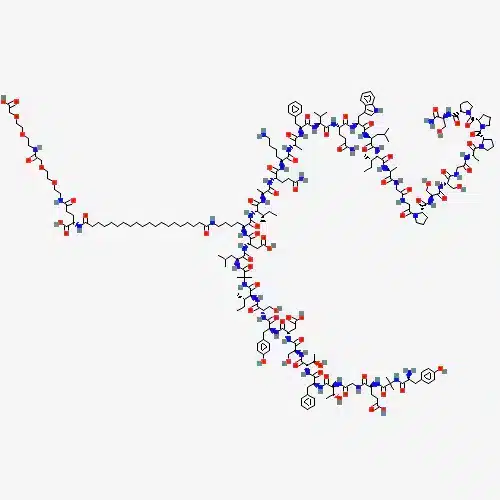
Structure of Semaglutide Peptide
Sequence: HXEGTFTSDVSSYLEGQAAK-OH.steric diacid-EFIAWLVRGRG
Molecular Formula: C187H291N45O59
Molecular Weight: 4113.64 g/mol
PubChem CID: 56843331
CAS Number: 910463-68-2
Synonyms: Semaglutide, Oxempic, Rybelsus, NN9535
Research Findings on Semaglutide
The Incretin Effect of Semaglutide
Perhaps the most important effect that Semaglutide has, according to Dr. Holst, is referred to as the “incretin effect.” Incretins are a group of metabolic hormones, released by the GI tract, that cause a decrease in blood glucose (sugar) levels. Semaglutide has been shown to be one of the two most important hormones (the other being GIP) to stimulate the incretin effect in rodent models. Though GIP circulates at levels roughly 10 times higher than that of Semaglutide, there is evidence that Semaglutide is the more potent of the two molecules, particularly when levels of blood glucose are quite high.
A Semaglutide receptor has been identified on the surface of pancreatic beta cells, making it clear that Semaglutide directly stimulates the exocytosis of insulin from the pancreas. When combined with sulfonylurea drugs, Semaglutide has been shown to boost insulin secretion enough to cause mild hypoglycemia in up to 40% of subjects. Of course, increased insulin secretion is associated with a number of trophic effects including increased protein synthesis, reduction in the breakdown of protein, and increased uptake of amino acids by skeletal muscle.
Semaglutide and Beta Cell Protection
Research in animal models suggests that Semaglutide can stimulate the growth and proliferation of pancreatic beta cells and that it may stimulate the differentiation of new beta cells from progenitors in the pancreatic duct epithelium. Research has also shown that Semaglutide inhibits beta cell apoptosis. Taken in sum, these effects tip the usual balance of beta cell growth and death toward growth, suggesting that the peptide may be useful in treating diabetes and in protecting the pancreas against insult that harms beta cells.
In one particularly compelling trial, Semaglutide was shown to inhibit the death of beta cells caused by enhanced levels of inflammatory cytokines. In fact, mouse models of type 1 diabetes have revealed that Semaglutide protects islet cells from destruction and may, in fact, be a useful means of preventing the onset of type 1 diabetes.
Semaglutide and Appetite
Research in mouse models suggests that administration of Semaglutide, and its similar cousin GLP-1, into the brains of mice can reduce the drive to eat and inhibit food intake. It appears that Semaglutide may actually enhance feelings of satiety, helping individuals to feel fuller and reducing hunger indirectly. Recent clinical studies have shown in mice that twice-daily administration of Semaglutide receptor agonists causes gradual, linear weight loss. Over a long period, this weight loss is associated with significant improvement in cardiovascular risk factors and a reduction in hemoglobin A1C levels, the latter of these being a proxy marker for the severity of diabetes and the quality of blood sugar control attained via treatment.
Potential Cardiovascular Benefits of Semaglutide
It is now known that Semaglutide receptors are distributed throughout the heart and act to improve cardiac function in certain settings by boosting heart rate and reducing left ventricular end-diastolic pressure. The latter may not seem like much, but increased LV end-diastolic pressure is associated with LV hypertrophy, cardiac remodeling, and eventual heart failure.
Recent evidence has even suggested that Semaglutide could play a role in decreasing the overall damage caused by a heart attack. It appears that the peptide improves cardiac muscle glucose uptake, thereby helping struggling ischemic heart muscle cells to get the nutrition they need to continue functioning and avoid programmed cell death. The increase in glucose uptake in these cells appears to be independent of insulin.
Large infusions of Semaglutide into dogs have been shown to improve LV performance and reduce systemic vascular resistance. The latter effect can help to reduce blood pressure and ease strain on the heart as a result. This, in turn, can help to reduce the long-term consequences of high blood pressure such as LV remodeling, vascular thickening, and heart failure. According to Dr. Holst, administration of Semaglutide following cardiac injury has “constantly increased myocardial performance both in experimental animal models and in patients.”
Semaglutide and the Brain
There is some evidence to suggest that Semaglutide can improve learning and help to protect neurons against neurodegenerative diseases such as Alzheimer’s disease. In one study, Semaglutide was shown to enhance associative and spatial learning in mice and even to improve learning deficits in mice with specific gene defects. In rats that over-express the Semaglutide receptor in certain regions of the brain, learning and memory are both significantly better than in their normal controls.
Additional research in mice has shown that Semaglutide can help to protect against excitotoxic neuron damage, completely protecting rat models of neurodegeneration against glutamate-induced apoptosis. The peptide can even stimulate neurite outgrowth in cultured cells. Researchers are hopeful that additional research on Semaglutide will reveal how it might be used to halt or reverse certain neurodegenerative diseases.
Interestingly, Semaglutide and its analogue exendin-4 have been shown in mouse models to reduce levels of amyloid-beta in the brain as well as the beta-amyloid precursor protein found in neurons. Amyloid beta is the primary component of the plaques observed in Alzheimer’s disease, plaques which, while not necessarily known to be causative, are associated with the severity of the disease. It remains to be seen if preventing amyloid beta accumulation can protect against the effects of Alzheimer’s disease, but this research is, at the very least, a tantalizing clue as to how scientists might intervene in the progression of mild cognitive impairment to full Alzheimer’s disease.
Semaglutide exhibits minimal to moderate side effects, low oral, and excellent subcutaneous bioavailability in mice. Per kg dosage in mice does not scale to humans. Semaglutide for sale at Peptide Sciences is limited to educational and scientific research only, not for human consumption. Only buy Semaglutide if you are a licensed researcher.
Packaging
Single vial containing lyophilized product. Each vial contains 6mg Semaglutide.
FAQ
GLP-1, or glucagon-like peptide-1, is a naturally occurring peptide hormone that primarily functions to lower blood sugar levels by enhancing insulin secretion. It also protects pancreatic beta cell insulin stores, reduces appetite by delaying gastric emptying, and has been linked to various physiological effects in the brain, heart, muscles, and other organs.
Semaglutide helps manage diabetes by stimulating the release of insulin from pancreatic beta cells in response to high blood glucose levels. This incretin effect improves blood sugar control and has been shown to reduce hemoglobin A1C levels, a key marker of diabetes severity and blood sugar management quality.
Yes, Semaglutide can aid in weight loss. Research indicates that Semaglutide reduces appetite and food intake by enhancing feelings of satiety. Clinical studies have shown that administration of Semaglutide receptor agonists leads to gradual, linear weight loss and improvements in cardiovascular risk factors.
Semaglutide has been shown to improve learning and memory, protect neurons against neurodegenerative diseases like Alzheimer’s, and reduce levels of amyloid-beta in the brain. These neuroprotective effects make Semaglutide a promising target for research into cognitive health and neurodegeneration.
Semaglutide exhibits minimal to moderate side effects, with the most common being gastrointestinal issues like nausea. It has low oral and excellent subcutaneous bioavailability in mice, but human dosage must be carefully controlled. Semaglutide is intended for educational and scientific research purposes only and is not for human consumption unless prescribed by a healthcare professional.
Disclaimer
This information is not intended to replace professional medical advice. Always consult with a healthcare professional before starting any new supplements.